Top-rated independent appliance repair across the Mid-South
Dishes Coming Out Dirty
Dirty dishes after a full cycle almost always come down to water temperature, spray pressure, or filth built up inside the machine itself. You opened the door and found grit on the plates, cloudy glasses, maybe sand in the bottom of a cup. Now you're rewashing by hand and wondering why you own the thing. Sort out which of those three it is and you'll know where to look.
Call (888) 857-9883- Real people on the phone
- 7 days a week
- Quote in writing before any work
Taking calls until 5:00 PM CT
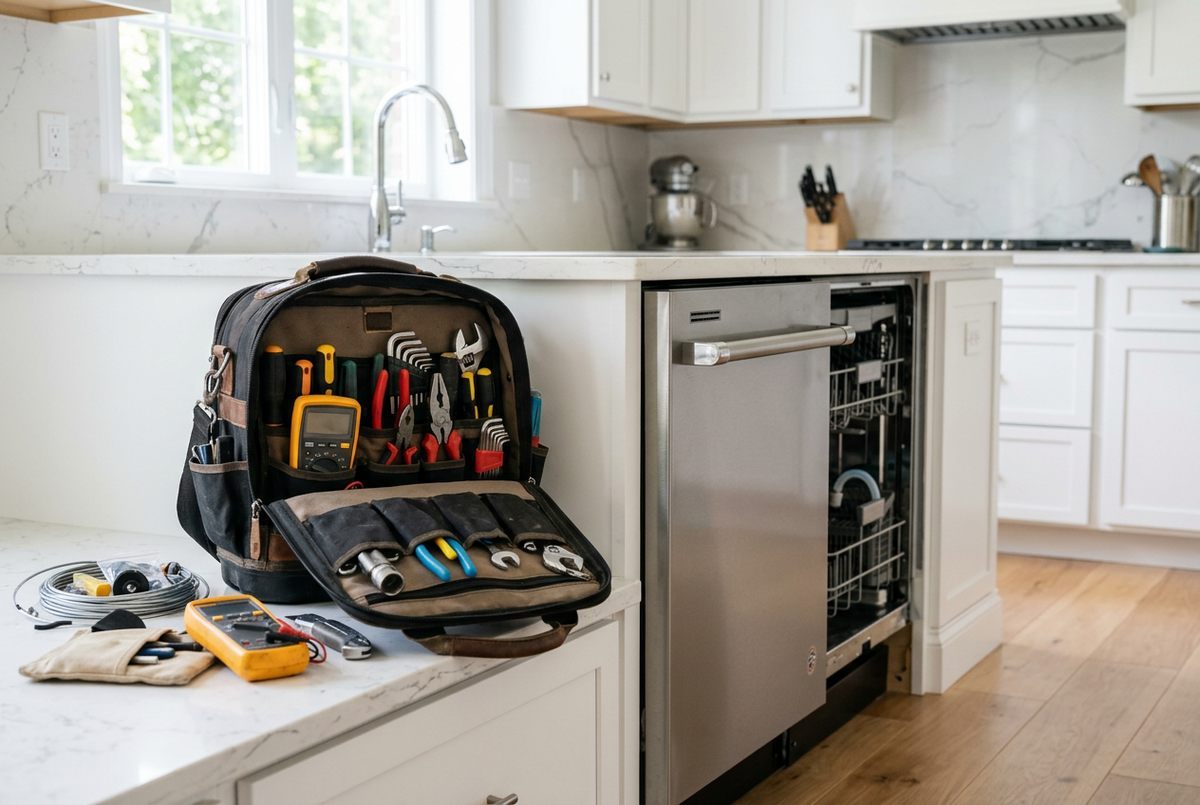
Logan Appliance Repair service team · field-reviewed before publishing
What "not cleaning" is really telling you
A dishwasher cleans with hot water, spray pressure, and detergent that dissolves at the right time. Take away any one and the dishes come out dirty. Grit and sand mean debris is getting recirculated. A white film on glasses points at hard water or detergent that never dissolved, and baked-on food on the top rack usually means the upper spray arm isn't spinning. If dishes come out wet and dirty with standing water in the bottom, that's a drain problem, not a wash problem. Sort the symptom first. Around here, well water and clay-heavy municipal supply both leave their mark, and that changes what we look at.
Start with the cheap stuff: filter, loading, detergent
Pull the bottom rack and look at the filter in the floor of the tub. Most machines made in the last fifteen years have one you can twist out by hand. Packed with paper labels, seeds, and grease? There's your grit. Rinse it under hot tap water with a soft brush. Next, look at how you load. Big platters across the front block the spray, and bowls nested together hide their own insides. Then check the detergent, because powder and tabs go stale in a humid Tennessee kitchen. Old detergent won't dissolve. Buy a fresh box and keep it sealed.
Water that isn't hot enough or hard enough to fight
Dishwashers want water near 120 degrees at the start of the cycle. Run the kitchen sink hot before you start the machine so the line is purged of cold water. If your water heater is set low, or the dishwasher sits a long way from it, that first fill comes in lukewarm and grease never lifts. Hard water is the other half of it. Minerals leave a chalky haze and dull the detergent. A rinse aid helps. So does running a cup of white vinegar through an empty hot cycle once a month. If the film is back within a week, you've likely got real hardness, not just buildup.
Spray arms and things that block them
Open the door and spin the lower spray arm with your hand. It should turn freely. Do the same for the upper arm and the little sprayer under the top rack if yours has one. Hold each up to the light and look at the holes, because toothpicks, seeds, and mineral scale plug them, and a straightened paper clip clears most of that. Also check that the upper rack isn't sagging or off its rails, since it can drop and stop the arm mid-swing. That's it for the safe checks. Don't pull the lower panel, don't unplug wiring, and don't pry the pump cover loose.
What we do that you can't from the kitchen floor
When the easy causes come up clean, we test the parts you can't see. We check the water inlet valve's actual fill volume, since a valve half-clogged with sediment fills slow and the cycle times out with a shallow pool. We measure the heating element and its thermostat to see if the machine is really heating between rinses. We look at the wash pump and its impeller for cracks that kill pressure. Storm-season surges here take out control boards, so we check whether the board is even calling for the heat and wash it should. Then we run a full diagnostic cycle and watch it. Call us and tell us what the dishes look like.
Dishes Coming Out Dirty — common questions
Should I rinse dishes before loading?
Scrape, don't rinse. Detergent needs some food soil to work against. Get the bones and rice off, then load. Heavy pre-rinsing is a common reason glasses come out etched and cloudy.
Why do only the top rack dishes come out dirty?
That points at the upper spray arm. Either it's clogged, a tall item is blocking it, or the feed tube in the back is scaled shut and no water is reaching it. Spin it by hand to check.
Can hard water damage the dishwasher?
Over time, yes. Scale coats the heating element and narrows the spray holes, so the machine works harder and cleans worse. Regular vinegar cycles and rinse aid slow it down considerably.
How it works
- Step 1
Tell us the symptom
Call us or fill out the form and tell us what you hear, smell, or see. Buzzing, leaking, no heat. Plain talk is fine. We'll ask a few questions and set a visit window.
- Step 2
We come look
A technician shows up in the window, pulls the unit out, and tests it. No guessing games. We explain what failed and why, in words that make sense on your back porch.
- Step 3
We fix it
Common parts ride with us, so a lot of repairs finish on that first visit. If a part has to be ordered, we tell you plainly and set the return date before we pull out of your driveway.
- A real person answers
- Open 7 days
- Written quote before work starts
Why homeowners call us
- Storm-season surge damageLightning and blinking power hurt control boards. You get an oven that lights up but won't heat, or a washer that quits mid-cycle. We test boards and wiring before we replace anything, so you know what the surge actually took out.
- Clay dust and lintRed clay dust and lint choke dryer vents and condenser coils. That's where long dry times and a hot laundry room come from, and it's why a fridge runs nonstop. We check airflow every visit, because a clogged vent kills a good machine slowly.
- Straight talk, no runaroundWe tell you what's wrong and what it takes to fix. If a machine is worn past sense, we say that too, and you decide. No pressure and no jargon. We don't dress up an upsell as advice.
- Independent and localWe're a Nashville crew, not a call center. As an independent shop we repair all major brands. Call us and you get a real person, somebody who knows the roads we drive.
- All major brands, gas & electricIndependent service on Whirlpool, LG, Samsung, GE, Maytag, Bosch, KitchenAid and the rest.
- Straight answersNot worth fixing? We say that out loud, and often it saves you the visit fee.
About this guide
Safe checks done and it still misbehaves? That's a real fault
Tell us what you tried and what it did. The booking itself takes a minute.
- A real person answers
- Open 7 days
- Written quotes
- All major brands
- Gas & electric
Rather not call? Get a free quote →